
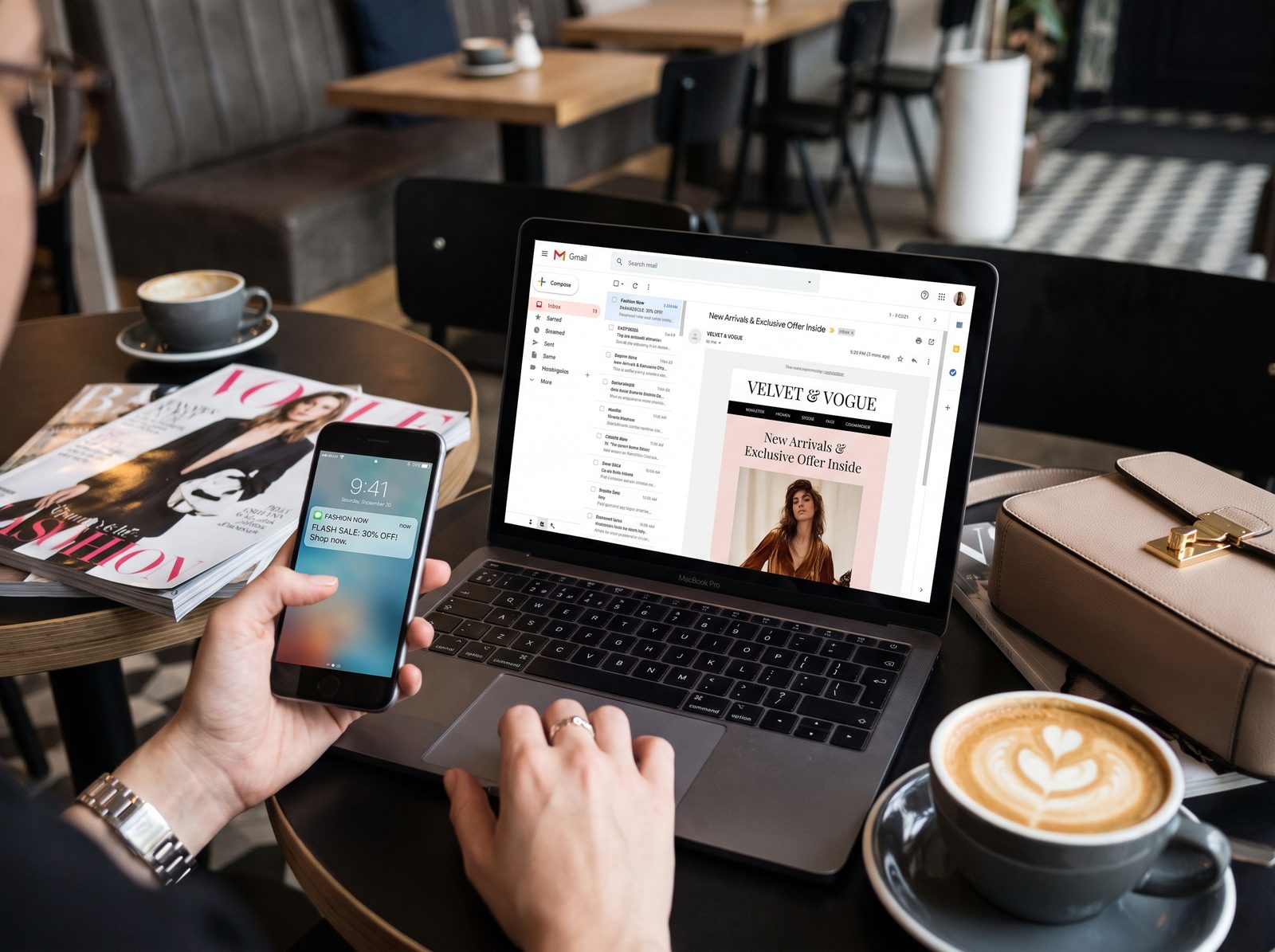
Email and SMS Marketing for Fashion Brands: The Flows That Sell Between Drops
Fashion built its marketing around the drop. The money, increasingly, is made in the weeks between drops, and the brands winning that stretch are running email and SMS flows most of their competitors never bothered to build.
The drop calendar is a beautiful thing for demand and a brutal thing for cash flow. You spend 6 weeks building a collection, sell hard for 5 days, and then the revenue line sags until the next launch. Most fashion brands answer that sag the same way: buy more traffic. Which worked, more or less, until the math turned against everybody at once.
By SimplicityDX‘s estimate, brands now lose an average of $29 on every new customer they acquire, with acquisition costs up 222% over the preceding decade. The first order stopped paying for itself a while ago; the profit lives in the second and third. Beauty brands internalized this early because replenishment forced them to. Jewelry brands run anniversary and occasion reminders for the same reason. Fashion, with no bottle that runs empty and no date to anchor a reminder to, mostly skipped the retention homework and kept writing checks to Meta.
The fix is unglamorous: a stack of automated email and SMS flows that sell to the audience you already own, triggered by what individual shoppers actually do, running around the clock whether or not anything new is launching. Here is that stack, flow by flow, with the timing, the segmentation, and the real brands running each play well.
Why Flows Outsell Campaigns When Nothing New Is Launching
First, the distinction that the whole argument rests on. A campaign is a broadcast: it goes out to the list when you have something to say, which in a drop-led brand means it clusters around launches and goes thin in between. A flow is an automation: it fires when a specific customer does something worth answering. Joins the list. Views the same jacket 3 times. Abandons a checkout. Receives a package. The trigger is their behavior, and their behavior doesn’t check your launch calendar first.
The economics of that difference are lopsided. In Klaviyo‘s benchmark data, automated flows generate roughly 41% of total email revenue from just 5.3% of sends. Per message, the automation out-earns the broadcast by an order of magnitude, and the reason is timing rather than copywriting genius: the flow arrives at the moment of intent, while the campaign arrives at the moment your content calendar said so. Between drops, campaigns give your list something to read. Flows do the selling.
The 6 Email and SMS Flows Every Fashion Brand Should Be Running
Every platform in this space, whether you run email and SMS together in Klaviyo or split them across Attentive, Postscript, or Sendlane, ships templates for all of these. The templates are a starting point, and most brands treat them as a finish line. The mechanics below are what separates a flow that pays rent from a flow that technically exists.
Welcome Series: The First 30 Days Decide the Second Purchase
The trigger is a signup, and the stakes are higher than the word “welcome” suggests, because this is the one flow every future customer passes through. The working shape is 3 to 5 emails: the incentive delivered within minutes, the brand story a day or so later (who makes this, why it exists, what it stands for), then best sellers with social proof, and, for apparel specifically, a fit and sizing email that does more conversion work than the discount. New subscribers haven’t tried your cuts yet; telling them “runs true to size, size up for the oversized fit” removes the exact hesitation that stalls a first order.
Segment by signup source, because context changes the job. Marine Layer runs 2 separate welcome flows: people who sign up online get pointed toward nearby retail stores, while people who sign up in a store get sold on the wider online selection and free shipping and returns. Same brand, same warmth, opposite assignments.
Done properly, this flow converts at rates campaigns never touch. Club L London, the UK occasionwear label, offers a first-purchase saving in its welcome flow and converts 11% of recipients, which Klaviyo reports as 5x the sector benchmark. Within a year of building out its automations, email and SMS accounted for 33% of the brand’s direct revenue, and the welcome and abandoned-cart flows between them generated most of it.
The incentive itself deserves a test rather than an assumption. When Barcelona’s Brava Fabrics tested its standard 10% signup discount against a contest entry for €300 of free product, the 2 offers performed identically. If a prize draw converts as well as a sitewide discount, the discount was never the reason people signed up, and you just bought your margin back.
Browse Abandonment: Low Pressure for Window Shoppers
Triggered when someone views a product, or several, without adding to cart. The volume here is far bigger than cart abandonment and the intent is far shallower, so the message has to behave accordingly: a browse-abandonment email that opens with urgency reads like a store clerk following you into the street. Send it 60 to 90 minutes after the session ends, show the piece they looked at, and surround it with styling context: what it pairs with, how it drapes, what else lives in that collection. Editorial, not enforcement.
2 guardrails keep this flow from souring. Suppress anyone who added to cart, because the cart flow takes over from there with a stronger message, and cap the frequency so a heavy browser doesn’t get 4 nudges in a week. The upside compounds when the product recommendations are actually personal: this is where recommendation engines earn their keep, and we’ve broken down how AI personalization drives fashion conversion separately. On SMS, Postscript’s apparel data shows browse texts converting at a fraction of cart-abandonment rates, which is exactly the point: this flow plants seeds, and the next one harvests.
Abandoned Cart and Checkout: Recovering the Sale You Already Earned
Just over 70% of online carts are abandoned, per Baymard Institute‘s running average across 50 studies, and fashion adds its own aggravators: shipping-cost surprise at checkout and the standing fear of ordering the wrong size. Which means the recovery sequence has objections to answer, not just a reminder to deliver.
The working structure is 3 touches. The first goes out within the hour, shows the exact items, and answers the 2 killer objections in plain sight: what shipping costs and how returns work. The second lands the next day with social proof or a styling angle on the abandoned piece. The third, at 48 to 72 hours, is where a discount may appear, if it appears at all, and it should be segmented: repeat buyers who happily pay full price don’t need to be trained to abandon carts for coupons. Club L’s first abandoned-checkout email converts around 11% on its own, before any follow-up, which is what “the money is already in the cart” looks like in practice.
Layer SMS into the middle of this sequence rather than duplicating the email. A single text between the first and second email, product image included, catches the phone-first shopper the inbox missed. In Postscript‘s fashion and apparel benchmarks, abandoned-cart texts earn between $3.75 and $10.38 per message sent, the strongest per-message economics of any standard automation in the channel.
Post-Purchase: Fit, Care, and the Path to Order 2
Here is the drop model’s blind spot in miniature: the sale closes, the shipping confirmation goes out, and the brand goes silent until the next launch blast. Meanwhile the customer is in the highest-attention window they will ever give you, tracking a package they’re excited about. The post-purchase flow fills that window with 4 jobs, in order. Confidence before delivery: order status, what to expect, the story behind what they bought. Fit and care after delivery: how to wash it, how to store it, how it should sit, which measurably lowers both returns and the buyer’s-remorse itch during the refund window. Then the review and UGC request, timed off the delivery date rather than the order date, and late enough that they’ve actually worn the piece. Then, and only then, the cross-sell into a second order, built from what they bought rather than from what you want to move.
Manchester streetwear label Represent runs its post-purchase journey through Attentive, layering new arrivals and bestsellers behind the transactional beats, and the journey converts at 22%. Roughly a third of the brand’s SMS subscribers have purchased at least twice since opting in, which is the entire retention argument compressed into a single line of a case study.
A detail worth stealing on the review ask: Brava Fabrics routes its review requests through a Typeform integration, steering 5-star responses toward a public review and lower scores toward customer service instead of a public airing. The flow works as a satisfaction filter and a service-recovery trigger at once.
Back in Stock: Fashion’s Highest-Intent Trigger
Sellouts aren’t a failure state in drop-led fashion; they’re the operating model. Which makes the back-in-stock flow the closest thing this category has to beauty’s replenishment engine, and it’s the automation fashion brands skip most often. The mechanic is simple: a “notify me” button on every sold-out size and colorway, and an automated message the moment inventory returns. The customer has written the message brief themselves, and it shows in the numbers. In Postscript’s apparel benchmarks, back-in-stock texts click through at 36% even at the 25th percentile and past 52% at the top, the highest engagement of any message type in the dataset.
The failure mode is mechanical rather than creative: a restock of 40 units, a waitlist of 900, and 860 people clicking through to a product that sold out again before lunch. Brava Fabrics solves it by releasing back-in-stock emails in small batches, 10 people at a time, letting the flow open the next batch only if inventory survives. Nobody clicks into disappointment, and the scarcity stays real instead of performative.
Run the waitlist data upstream, too. Which styles, sizes, and colorways stack the longest queues is a free demand forecast, and it should be sitting in front of whoever decides what gets re-cut for the next drop.
Winback: Timed to Your Drop Cadence, Not a Default Template
The stock winback template fires at 90 days of inactivity because it was built for categories where people buy monthly. Fashion purchase cycles follow seasons, paydays, and your own release rhythm, so set the window from your data instead: pull the median gap between a customer’s first and second order (Klaviyo’s predictive analytics will estimate an expected next-order date per profile), and trigger the flow when a customer sails meaningfully past it. For a brand dropping every 6 weeks, a lapsed customer is someone who has ignored 2 full drops, and that framing writes the message for you: here’s what you missed, here’s what’s coming, no groveling. “We miss you” is a subject line, not a strategy. Save the discount for the final touch, if your margin allows one at all.
The winback flow also has an unglamorous second function: deciding who leaves. After the sequence runs its course with no engagement, suppress the address. The bulk-sender rules Gmail and Yahoo rolled out in 2024 punish brands that keep mailing dead inboxes, and every zombie address on your list drags down deliverability for the subscribers who actually buy. A smaller list that lands in the inbox beats a bigger list that lands in spam, every time it’s tested.
SMS on Drop Day: Early Access, Scarcity, and the 48-Hour Window
Everything above runs in the background. Drop day is the foreground, and it belongs to SMS. Email gets opened on the recipient’s schedule; a text gets seen on yours, which matters enormously when the product is gone in hours. The trade is attention for restraint: a channel this direct stays powerful only if you keep it scarce between launches. Brands that text like they email train their list to opt out.
Who Gets the Early-Access Text
Early access is the strongest offer in fashion SMS, stronger than a discount, because it sells status and certainty instead of cents off. Represent gives SMS subscribers and loyalty members early entry to major sales, and its early-access sends have hit a 19% click-through with a 53% conversion rate among clickers: numbers that only happen when the audience was pre-qualified by its own behavior. The brand builds those tiers through LoyaltyLion and segments by engagement, so the people getting the first text are the people who earned it.
Victoria Beckham‘s team runs the same logic at luxury scale, where some releases carry only 7 to 20 units. Less-engaged subscribers are excluded from sale notifications entirely, loyal ones get first access to new collections, and sends are timed around common shopping cycles like paydays. When 20 units exist, “the right message to the right person” stops being a platitude and becomes inventory allocation.
The Drop-Day Sequence
The launch itself is a 4-message arc, not a single blast:
- The teaser, 24 to 48 hours out: a single image or a date, no link. Anticipation is the product.
- The early-access text to VIPs, a few hours before the public gets in, with a direct link. This is the reward that makes the SMS opt-in worth having.
- The live text to the full engaged list the moment the drop opens.
- The last-call or low-stock text, sent only when it’s true. Fake scarcity burns the exact trust this channel runs on, and your waitlist data will expose it anyway.
Whatever sells out feeds straight back into the back-in-stock flow, and that waitlist becomes your pre-sold audience for the re-cut. And the stored energy in a well-built list is real: Marine Layer’s first SMS campaign after launching the channel drove more than $80K in revenue inside 24 hours. That text didn’t find new customers. It reached people the brand already owned, on a channel that finally matched their attention.
The Between-Drops Calendar: What to Send When Nothing Is New
With the flows live, the campaign calendar’s job changes. It no longer has to manufacture revenue out of a quiet month; it has to keep the brand warm and keep feeding people into the automations. The cycle between 2 drops breaks into 3 stretches.
Right after the drop, resist the urge to keep shouting. The post-purchase flow owns the conversation with buyers; campaigns serve the people who didn’t buy, with styling editorials of the new collection, restock alerts as they happen, and the social proof rolling in from early customers.
Mid-cycle is where most brands either go dark or go desperate, and both are wrong. This is the stretch for editorial campaigns: how customers style the pieces, the making-of material from production, archive edits, a founder’s note that reads like a person wrote it. Send steadily, but to engaged tiers (30-, 60-, 90-day engagement segments), not to the full file. The revenue math already forgives the modest campaign numbers: in Postscript’s apparel data, campaign texts earn somewhere between $0.11 and $0.52 per message while the automations earn dollars. Campaigns exist to generate the browsing, carting, and signups that the flows then convert. Worth saying: every one of these emails leans on the quality of your imagery, and a between-drops calendar is much easier to fill when your fashion product photography system produces styling and detail shots in volume rather than launch heroes alone.
The run-up to the next drop flips the acquisition logic. This is when SMS list growth is cheapest, because the offer writes itself: early access to the drop, not 10% off. A signup unit that says “texts get in first” converts the exact high-intent shopper you want on that list, and the teaser arc gives new subscribers an immediate payoff for joining. Fashion brands sit on a list-growth engine most categories would kill for; a drop is a recurring reason to hand over a phone number.
If You Have None of This, Build in This Order
A brand starting from a bare Klaviyo account shouldn’t build 6 flows at once. Sequence them by proximity to money:
- Abandoned cart and checkout, email plus 1 SMS touch. Highest intent, fastest payback, and the benchmark data above says this is where the dollars-per-message live.
- Welcome series. Every drop drives a signup spike; without this flow, each spike evaporates unmonetized.
- Back in stock. Your model produces sellouts on schedule. Stop letting them end the conversation.
- Post-purchase. Fit and care content first (it pays twice, in returns saved and trust built), then the review ask, then the cross-sell.
- Browse abandonment. A volume play that works best once your deliverability and templates are proven.
- Winback. Last, because it needs your own purchase-cycle data to time well, and by the time it matters you’ll have it.
None of this replaces the drop. The drop is the acquisition engine, the cultural moment, the reason anyone handed over an email address in the first place. The flows are the margin engine that runs while the next collection is still on the cutting table. Paid social will keep getting more expensive, and the list you already own will keep costing almost nothing to talk to. Build the machine before the next launch, and drop day stops being the only day your revenue line moves.