
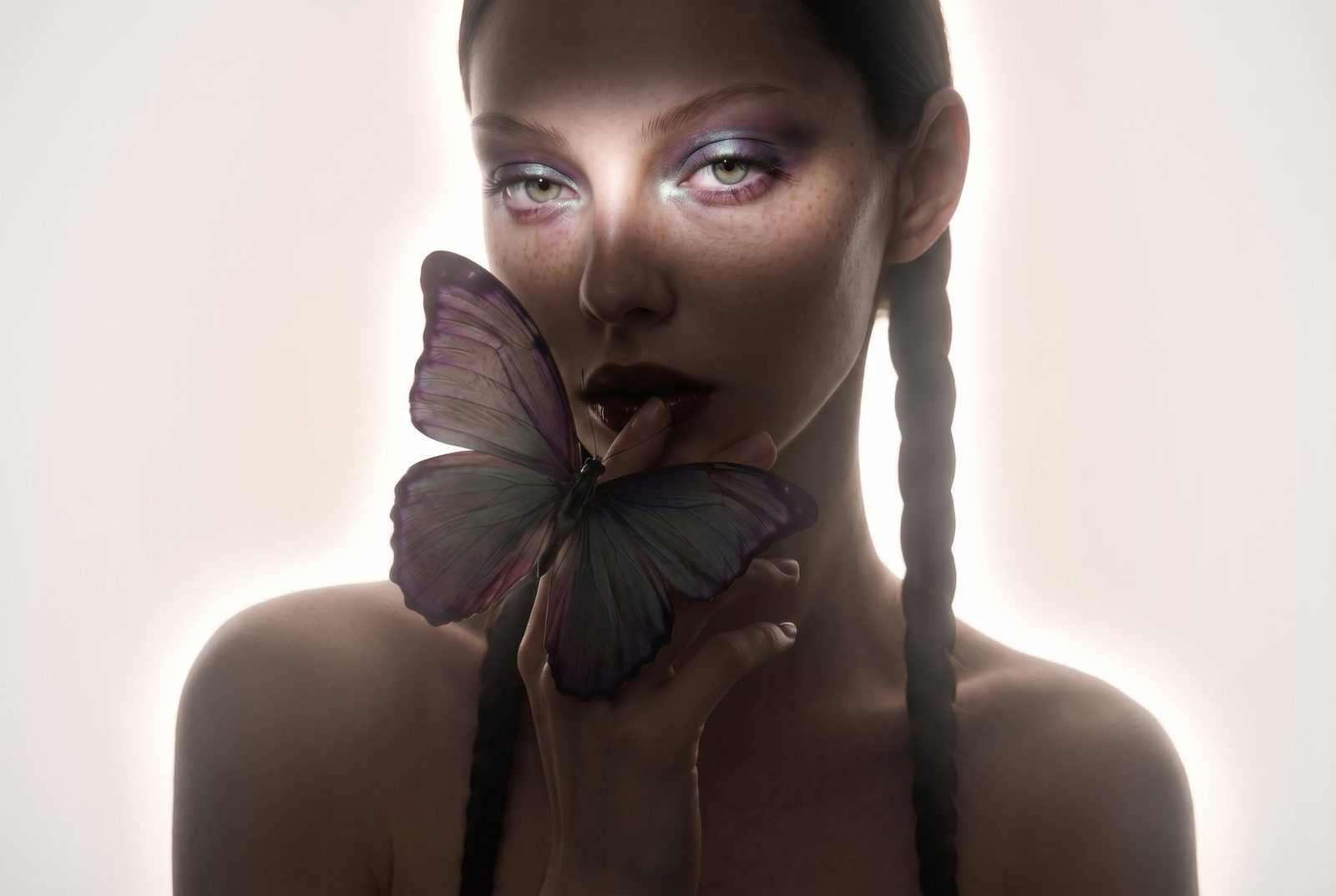
AI Cosmetic Product Photography: Packshots, Swatches, and the Texture Layer
A decade ago the beauty packshot did the selling: bottle, gradient background, done. Then Glossier built a billion-dollar-scale brand with imagery that looked like your most photogenic friend’s bathroom counter, customer photos and dewy real skin over studio gloss, and the category’s visual grammar flipped.
What converts now is proof of experience: the texture pull, the swatch on real skin, the goop shot that answers “what does this actually feel like” through a screen. The Earned Media Value economics reward the same shift, because earned media runs on images people want to repost, and nobody reposts a bottle on a gradient. rhode is the proof of scale: in the 12 months ended March 31, 2025 it ran $212 million in net sales and became the No. 1 skincare brand in Earned Media Value, up 367% year over year, on the way to a deal with e.l.f. Beauty valued at up to $1 billion, per e.l.f. Beauty’s own announcement. The camera moved from the packaging to the product’s behavior, and the winning brands shoot behavior on purpose, in volume.
Volume is the part owners underestimate. EMV compounds on repostable imagery published relentlessly, week after week, across owned channels and hundreds of creator feeds, which means the winning brands operate visual production like a publishing schedule rather than a campaign calendar. A beauty brand that produces 12 beautiful images a quarter is not playing the same sport as one producing 12 a week, and the gap between those 2 numbers is a production-system question, not a creativity question.
The 5-Shot Cosmetic Product Photography System
Cosmetic product photography is the set of 5 shot types that sell a beauty product online: the packshot, the texture shot, the swatch, on-skin application, and lifestyle context. A brand needs all 5 as a system, produced consistently across the catalog, because each answers a different pre-purchase question and each has a different destination. Here is each one, with where it earns its keep.
1. The Packshot
Still the workhorse: product upright, lit clean, on white or brand-neutral ground. It anchors the first product-page slot, every retailer grid, and the shopping feed, and its job is identification and trust rather than seduction. The discipline that matters is catalog-wide consistency, one white point, one shadow logic, one scale logic across every SKU, because your products are seen as a shelf, on your own grid and on retailer pages, and a mismatched shelf reads as a brand that does not sweat details. In a category selling precision on skin, that read is expensive. The mechanics are unglamorous: 1 lighting recipe documented and reused, 1 camera-to-export color pipeline, product centered and scaled by a written rule rather than by eye, and the standard applied backward to the old SKUs, because the catalog is judged by its weakest packshot, not its newest.
2. The Texture Shot
The macro of the product out of its container: the balm’s surface, the serum’s viscosity on a dish, the powder’s crush. This is the shot that does the sensory translation, and the shot beauty shoppers linger on, which is why it earns a top-3 gallery slot on the product page and carries a disproportionate share of social and ad creative. It is also technically the least forgiving: texture reads through micro-detail, and micro-detail punishes lazy lighting. Shoot the real formula, always. The texture shot is a claim about what is in the jar.
3. The Swatch
Shade-range swatches on real skin, across genuinely different skin tones, are simultaneously a conversion asset, an inclusivity statement, and a legal-adjacent accuracy exercise. The swatch is where a wrong color costs the most: a foundation or lip shade that renders warmer on the page than in the tube is a guaranteed return and a burned repeat customer. Swatches belong on the PDP shade selector, in the gallery, and in ads targeted by shade family, and they are the one shot type where the rule is absolute: photographed, color-managed, never synthesized.
The production protocol is boring on purpose: the same daylight-balanced lighting setup for every shade in the range, the same application amount and stroke, a color reference target in frame on every capture, and one person owning the color pipeline from camera profile to exported file. Shoot the full shade range in 1 session whenever the line allows it, because “we will match the light next month” is how ranges end up with 3 different skin-tone renderings across 1 shade selector.
4. On-Skin and On-Model
Application imagery, the product mid-use on a real face or hand, is the beauty equivalent of fashion’s on-model shot: it sells outcome and it sets expectation. It feeds the later PDP gallery slots, organic social, and email, and the honesty bar is the familiar one, real product on real skin, with retouching that stops before it falsifies what the formula does. A customer comparing her cheek to your model’s cheek is running a controlled experiment on your integrity.
5. Lifestyle
The counter shot, the gym-bag shot, the morning-light-shelfie: context imagery that places the product in a life. This register fills feeds, creator briefs, and marketplace secondary slots, and it is deliberately looser, which is exactly why it scales well and why it is the natural first territory for the AI layer below. The Glossier lesson lives here: looser does not mean careless, it means art-directed to look effortless, which is its own craft.
Where Those Shots Go
The 5 shot types only become a system when each one has a destination map, so here is the working version. The product page runs the persuasion sequence: packshot first for identification, texture in slots 2 or 3 to sell the feel, the swatch set adjacent to the shade selector, application mid-gallery as outcome proof, lifestyle closing the set, inside the 5-to-8-image baseline that governs any PDP. Retailer product pages take the packshot and the swatch set and little else, on their templates and their pixel specs, which is exactly why your packshot standard has to be non-negotiable. Email leans on texture and application, the 2 registers that survive small render sizes with their appetite intact. Paid social burns creative fast and feeds on texture macros and application clips repackaged weekly, while organic and creator channels live almost entirely in the UGC-style register. Map a season’s production against those destinations before anyone lifts a camera, and the shot list writes itself; skip the map and you get the classic beauty-brand failure, a beautiful campaign folder and an empty email template.
The AI Layer: What MAC and Estée Lauder Are Doing
The shift under the shift: in March 2025 The Estée Lauder Companies announced a partnership with Adobe to put Firefly generative AI inside its marketing production workflows, with MAC Cosmetics as the first brand in the portfolio to work with it, per Estée Lauder’s announcement. Note what ELC is actually automating, because it is the least glamorous line in the release: features like Generative Expand resize and re-frame existing campaign images for every format and channel, so 1 finished asset becomes a dozen deliverables without a dozen production rounds. The multibillion-dollar owner of La Mer bought the world’s fanciest image-resizer, and that is the point. The product imagery itself stays photographed; the AI multiplies it. That is the pattern worth copying, and it is the same catalog-to-campaign architecture we map in the AI product photography playbook.
What AI Does Well in a Beauty Pipeline
2 jobs, all safely behind the camera line.
Background and scene work: the photographed product moves from white ground to a generated marble counter or beach towel without touching a product pixel.
Lifestyle and brand-world imagery, where no shade or texture claim is being made, can be generated around real product photography at a pace a feed actually demands.
Where AI Lies: Shade and Texture
Generative models do not know your formula; they know what lip gloss tends to look like. Left unconstrained they will shift a shade half a tone warmer, add shimmer a matte formula does not have, and render a “plausible” viscosity that belongs to no product you sell. In beauty that is not a quality problem, it is a misrepresentation problem, because shade and texture are the product claims.
The operating rule is the same one that governs the swatch: anything that communicates color, finish, or texture gets photographed and color-managed; AI touches everything around it. If a tool cannot guarantee your product pixels survive untouched, it does not belong in the beauty stack. When the need is a single, color-accurate capture per SKU rather than volume, that is a live-studio job with its own discipline of lighting, calibration, and honest retouching.
The Impossible World: Beauty’s Surreal Scale
Beauty imagery does not always have to look natural, and often it should not. The category that proved it is Maybelline, which in 2023 ran giant mascara wands brushing enormous lashes fixed to London buses and tube trains, a “faux out-of-home” campaign made with animator Ian Padgham that many viewers believed was a real installation (Creative Bloq). The mascara was the real product; the giant scale and the moving bus were built.
For a beauty brand the creative upside is exactly this: place a real bottle, palette, or wand in a world scaled to the feeling you want, a lipstick the size of a building, a serum drop the size of a pool. It is the surreal counterpart to the swatch discipline, and it obeys the same rule from the other side, the product stays real and color-true while the world around it goes impossible. That work was CGI; AI now makes the still-frame versions of it quickly and cheaply, which is why surreal-scale beauty imagery has moved from luxury-budget stunt to something a smaller brand can test. Keep it where it belongs, in campaign and social, not on the shade selector, and the impossible world costs the brand nothing in trust.
The Honesty Rules Beauty Cannot Ignore
Beauty draws more scrutiny on image honesty than any other category, so the disclosure picture is worth stating on both sides. In the US there is no single AI deadline, but the Federal Trade Commission can already treat a misleading before-and-after or a faked result as a deceptive practice, and its Rule on the Use of Consumer Reviews and Testimonials (16 CFR Part 465, effective October 21, 2024) bans fake and AI-generated reviews and fake engagement, with penalties up to $51,744 per violation, which is exactly why synthetic beauty UGC is a bad bet. In the EU, transparency obligations under the AI Act begin applying on August 2, 2026, and California’s AI Transparency Act (SB 942, pushed to the same date by AB 853) lands alongside it. Keep generation in the backgrounds and formats, keep the shade and the payoff real and filmed, and the rules take care of themselves.
The Next 90 Days
The operator sequence, in order of return: first, audit the catalog against the 5-shot system and list every SKU missing a texture shot or a real swatch set, because those gaps are lost conversions today. Second, fix consistency: one packshot standard, applied to the whole catalog, including the old SKUs everyone stopped looking at. Third, stand up the AI layer for versioning and scenes only, with the product-pixel rule in writing. Fourth, feed the loose registers weekly, because the EMV game rhode just monetized is won on volume of postable imagery, not on 1 perfect campaign.
That is a real quarter of production work, and production is the operative word, not inspiration. The brands winning this are not more creative than you; they are more organized about the camera. Tuple Strategy exists for exactly that: we take a beauty catalog and deliver the full system, honest packshots to texture macros to the AI-multiplied channel versions, art-directed so it all looks like one brand instead of 40 moods. If your gallery still opens on a bottle floating over a gradient, let’s fix the shelf.