
How to Plan a Fashion Campaign: From Concept to Asset Rollout
Campaign imagery that looks effortless is the most planned object in fashion. Here is the actual process, phase by phase, from the first line of the brief to the last cropped asset.
When Skims released its Valentine’s Day campaign in January 2024, the images read like found Americana: Lana Del Rey in blue velvet and lace, shot by Nadia Lee Cohen on sets built to look like vintage pin-up postcards. Within 4 days the campaign had earned $13.7 million in media impact value, more than $4 million of it from a single post on Del Rey’s own Instagram, per Launchmetrics figures reported by WWD. Behind the pictures sat a Valentine’s shop of 29 limited-edition collections, stocked, priced, and sequenced before the first image went live.
Nothing about that outcome was improvised. The casting matched the moment: an artist whose entire aesthetic is romantic Americana, fronting a Valentine’s launch. The photographer was chosen because that exact world is her signature. The drop was timed to a retail window the brand had been training customers to expect for years. That is what a campaign actually is: a commercial bet planned backward from a launch date, where the beautiful pictures are one line item among many. This guide walks the whole process in 7 phases, the way brands that do it well actually run it, ending at the step most teams underestimate: producing and rolling out the assets themselves.
What a Fashion Campaign Is: 1 Idea, 1 Window, Many Assets
A fashion campaign is a single creative idea executed across every channel a customer touches, inside a defined launch window, in service of a specific commercial goal. That definition sounds obvious until you audit what many brands call a campaign: a photoshoot, posted until the images run out. A shoot produces pictures. A campaign produces a moment, and the moment only happens when the product pages, the social feeds, the email program, the paid ads, and the store all change at once and say the same thing.
Campaigns hang on occasions, and naming yours is the first planning decision: a seasonal collection (SS/FW), a product launch, a collaboration, a tentpole retail moment like Valentine’s or holiday, or a brand statement that resets how the label is read. Each occasion implies a different asset load and a different clock. A collab wants teasers and a synchronized reveal; a seasonal campaign wants a lookbook layer and a long sustain; a retail moment wants conversion assets above all, because the window closes on a fixed date whether you are ready or not.
Phase 1: The Brief and the Big Idea
The Campaign Brief: 7 Lines That Decide Everything Downstream
Every expensive mistake in a campaign can be traced to a line missing from the brief. Agencies have compressed brief-writing into formulas for a reason; the classic strategist’s version reads “get [audience] who [believes X] to [do Y] by [saying Z],” and it forces the discipline a mood board never will. Before anyone opens Pinterest, write these 7 lines and make the founder sign them:
- Objective: 1 commercial sentence. “Sell through the 40-piece capsule in 6 weeks” and “reposition the brand for a younger buyer” produce different campaigns; pick one to lead.
- Audience: a person, not a demographic. Who is she, what does she already wear, where does she scroll?
- Single-minded proposition: the one thing the campaign says. One. Everything else is support.
- Reasons to believe: the product truths that back the proposition: fabric, cut, provenance, price logic.
- Deliverables: the full asset list by channel, drafted now, not after the shoot (Phase 4 makes this a grid).
- Budget and mandatories: the number, the deadline, the logo rules, the things legal will not bend on.
- Success metrics: chosen before launch, matched to the objective (Phase 7), so nobody retrofits a victory later.
The Big Idea Test: Would It Survive an 8-Second Clip?
In April 2023, Jacquemus posted an 8-second clip of Bambino handbags the size of city buses driving through Paris. The bags were CGI, built by 3D artist Ian Padgham of Origiful, and the clip out-traveled entire seasons of conventional campaign spend while costing a fraction of a single shoot day, as Paper’s interview with Padgham lays out. Half the industry drew the obvious lesson, spent the next year making fake out-of-home videos, and produced a landfill of forgettable renders. The real lesson sits earlier in the process: the idea fit in a sentence. What if the bags were cars. Simple enough to land in 8 seconds, strange enough to argue about, and unmistakably Jacquemus, a house that had been doing surrealist scale jokes with giant hats and micro bags for years.
That is the test to run before you commit budget. Can you state the idea in 1 sentence? Can a colleague who was not in the room extend it into an email subject line and a billboard without calling you? Does it contain an image nobody has seen before? If the answer to the third question is no, you do not have a campaign idea yet, you have a genre reference, and genre references photograph beautifully and disappear without a trace.
Phase 2: Audience and Insight
“Women 25 to 40 who love fashion” is not an audience, it is a census category. A usable campaign audience is narrow enough to cast against: you should be able to say what she saved to her boards last month, which 3 brands she cross-shops, and what would make her screenshot your image and send it to a group chat. If your team cannot answer those questions, spend a week in your own DMs, reviews, and post-purchase surveys before you spend a dollar on production.
The insight is the tension that makes the idea land now rather than whenever. Go back to the Skims example: the insight was not “people buy lingerie for Valentine’s Day.” It was closer to “the internet’s reigning romantic melancholic fronting a holiday about romance is a casting so correct it becomes news.” Timing, casting, and cultural mood collapsed into a single decision. Write your insight as a sentence your customer would nod at, not a sentence a strategy deck would applaud, and check it against the calendar: a campaign with no reason to exist this season will be treated by the feed as exactly that.
Phase 3: Casting, Locations, and Crew
Casting Is a Message Before It Is a Face
When Heaven by Marc Jacobs launched, creative lead Ava Nirui had the lookbook shot by Shoichi Aoki, founder of the Japanese street-style bible FRUiTS, and cast musicians like beabadoobee and Vegyn, with typography by filmmaker Gregg Araki, as covered in Dazed’s launch interview. None of those choices optimized for reach. All of them told a precise subculture: this line is by people who worship what you worship. Heaven became a cult commercial success on the strength of that signal, and its castings were treated as news by exactly the audience it wanted.
The operational takeaway for a smaller brand: brief your casting on who the audience admires, not on what the models should look like. A recognizable face from your customer’s actual world (a niche musician, a local athlete, a cult stylist) buys more credibility per dollar than an anonymous model with perfect measurements. And put approvals in the contract conversation early: talent usage rights are priced by channel, territory, and duration, and the OOH or paid-media usage you forgot to negotiate will cost multiples later.
Location and World-Building: The Aimé Leon Dore Method
Aimé Leon Dore built one of the most imitated brand worlds in menswear largely through where it shoots. Its seasonal lookbooks live in real New York environments (corner delis, basketball courts, side streets, vintage cars) with clothes styled the way people actually wear them, and that world existed in the imagery before the product range was wide enough to fill it. The location was never a backdrop; it was the argument. Customers were buying entry into Queens-inflected New York classicism, and every frame restated the offer.
Practically: scout 2 to 3 weeks before the shoot, secure permits and a weather backup, and choose between studio and location on message grounds, not convenience. Studio gives control and speed for conversion assets; location carries the world-building weight that makes a campaign feel like it happened somewhere. Many strong campaigns split the difference, shooting PDP and detail coverage in studio and the narrative layer on location in the same production week.
The Crew and the Treatment
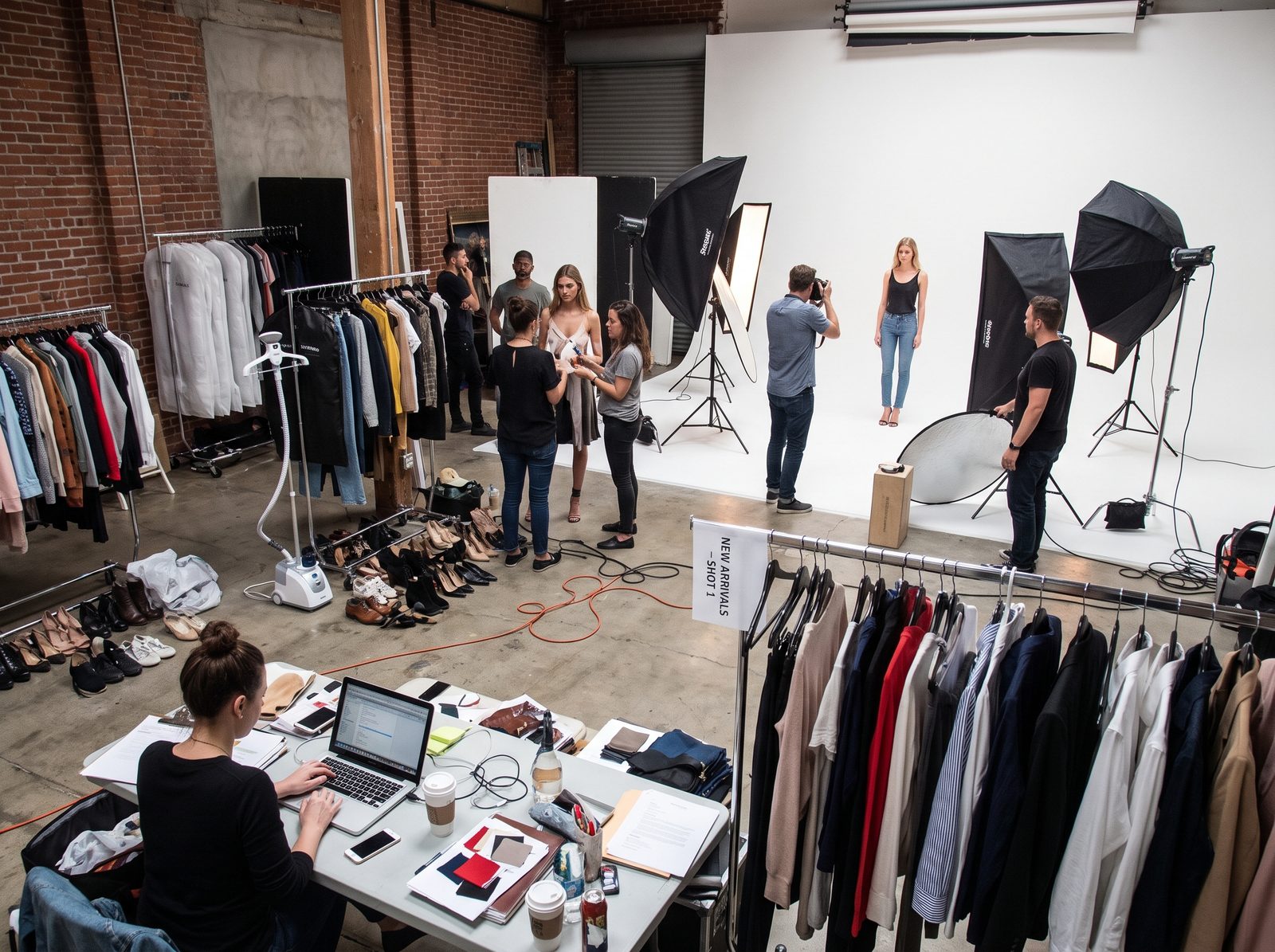
Hire the photographer or director for their signature, not their availability; Skims did not book Nadia Lee Cohen and then ask her to shoot clean e-commerce. Ask shortlisted creatives for a treatment, the short document where they interpret your brief into references, lighting, casting notes, and a shot approach. The treatment is where you discover misalignment while it is still free to fix. Around the lens, budget for the roles that protect the plan: a producer who owns the schedule and the money, a stylist, hair and makeup, and a digital tech running ingest and backup on set. On lean productions people double up, but the producer role never disappears, it just lands on whoever is least prepared for it. If assembling that crew yourself is the part that scares you, buying the capture layer as a package is a legitimate move: a studio like LenFlash in New York has shot apparel to retail spec for 2 decades with professional retouching included, no extra fees, which turns the riskiest week of the calendar into a booking.
Phase 4: The Asset Matrix and the Shot List
This is the phase that separates campaigns that roll out from campaigns that trail off. Nike’s “Winning Isn’t for Everyone” for the 2024 Paris Olympics is the architecture at full scale, per Wieden+Kennedy’s case page: 1 anthem film narrated by Willem Dafoe, a slate of individual athlete films cut from the same spine, and multi-city out-of-home carrying single lines like “My dream is to end theirs.” 1 idea, 3 asset altitudes, each composed for its medium rather than cropped down to it. You will not have Nike’s budget. You can absolutely have Nike’s structure.
Map Every Channel Before You Plan a Single Shot
Build a grid: channels down the side, asset types across the top, quantities in the cells. This is the asset matrix, and it is the shoot’s real client. A workable starting checklist for a fashion campaign:
- PDP: 5 to 8 images per campaign SKU: on-model front and back, detail, texture, and a scale reference, with campaign variants staged to swap in on launch morning. This is where the click lands, and it is the asset set brands most often forget to refresh.
- Organic social: 9:16 video for Reels and TikTok composed vertical in-camera, 4:5 stills for feed, plus behind-the-scenes coverage shot on set, which routinely outperforms the polished layer.
- Paid: every placement ratio with text-safe margins, and 3 to 5 opening-hook variants of the hero video so the ad account has something to test instead of 1 exhausted file.
- Email: hero crops that survive a 600-pixel-wide render, product grids, and variants for the launch send, the reminder, and the last-chance send in a platform like Klaviyo.
- OOH: extreme horizontal and vertical formats, 1 line of copy maximum, art direction legible at 50 meters and 50 milliseconds.
- Retail and wholesale: window prints at production resolution, in-store screens, and the lookbook buyers will judge the season by.
Writing the Shot List and Storyboard
Now, and only now, write the shot list, and write it as a mapping: every cell in the matrix points to a numbered shot. Structure it in 4 layers: hero looks (the frames that define the campaign), secondary looks (coverage across the range), detail and texture (the macro layer PDP and email depend on), and motion (the film beats, storyboarded, plus loose coverage for cutdowns). Add margin for the unplanned frame; the image that carries a campaign is often the one shot between setups. But margin is a buffer on a plan, not a substitute for one. If a channel has no line on the shot list, launch week will serve it a crop that was never composed, and it will look exactly like what it is.
Phase 5: The Production Calendar: A 12-Week Fashion Campaign Timeline
Campaigns are planned backward from the launch date, because the launch date is the one variable that will not move. A 12-week backward schedule that holds for most independent fashion brands:
- Weeks 1-2: brief signed, budget locked, big idea chosen and stress-tested against the 1-sentence rule.
- Weeks 3-4: creative team hired off treatments, casting brief out, location scouting starts.
- Weeks 5-6: casting confirmed and contracted with usage terms, locations permitted, asset matrix and shot list finalized.
- Weeks 7-8: pre-production: samples pulled and fitted, styling locked, sets built, call sheets issued.
- Week 9: shoot days, with the shot list as law and the producer as its enforcer.
- Weeks 10-11: edit and retouch (2 rounds, cap it), then the unglamorous half of post: every cutdown, crop, and format in the matrix actually produced and named.
- Week 12: trafficking: PDP variants staged, emails scheduled, ads submitted for review, OOH and retail files shipped to their printers’ deadlines, which are earlier than you think.
4 things blow this schedule up with remarkable consistency. Samples arrive late, so the shoot happens on prototypes with wrong trims and a retoucher inherits the difference. Talent approvals stall, because celebrity and even mid-tier creator contracts include image approval, so build 1 to 2 weeks of it into weeks 10-11 rather than discovering it in week 12. Retouching creeps, round 3 becomes round 5, and the matrix work gets crushed against the deadline. And the asset gap surfaces at trafficking: the email hero that does not exist, the 9:16 that was framed horizontal. Every one of these is survivable in week 6 and fatal in week 12, which is the whole argument for planning the boring parts first.
Phase 6: The Campaign Budget: 3 Buckets and 1 Ratio
Budget the campaign in 3 buckets and keep them honest against each other. Production covers crew, talent day rates, locations, set, styling, and post. Usage and licensing covers what you pay to run the faces and the music where and for how long you actually plan to; it is a separate bucket because it behaves like one, scaling with channels and time rather than with shoot days. Distribution covers media and the working-asset production that media requires. The classic failure is pouring everything into bucket 1: a gorgeous shoot, no money to put it in front of anyone, and a media plan fed with 1 hero file it will burn out in a week. (For what production itself costs across studio, UGC, and AI routes, we have broken that down separately.)
On the media side, the most defensible allocation guide in the industry remains Les Binet and Peter Field’s finding, published by the IPA, that budgets weighted roughly 60/40 between brand building and sales activation outperform over time. A campaign is by definition a brand-building burst, but the 40 matters: the retargeting, the PDP refresh, the conversion creative that catches the demand the pretty films create. And keep a contingency line. Producers reach for it on every production ever mounted, and the ones who did not budget it reach for the founder’s phone instead.
Phase 7: Rollout and Measurement
The Rollout Sequence: Tease, Drop, Sustain
A rollout is a sequence, not a publish button. The week before launch, tease: cropped fragments, a casting reveal, whatever earns speculation without spending the reveal itself. On launch morning, flip the channels in order of where money changes hands: PDP first, because every click from everything else lands there; then email to the house list; then organic social; then paid, once organic signal tells you which asset is the horse. Weeks 2 through 6 are the sustain, which is where the asset matrix pays for itself: cutdowns, alternate stills, behind-the-scenes, creator and press pickups, each landing as a fresh reason to look. The most common rollout failure in fashion is painfully simple: the campaign is live on Instagram while the product pages still show last season’s studio images, so the customer clicks from the new world into the old one and the spell breaks at the exact moment it was supposed to convert. (On what happens after the click, see our piece on AI and fashion eCommerce conversion.)
Bottega Veneta and the Right to Choose Your Channels
Rollout plans have a default settings problem: every channel, because the channels exist. Bottega Veneta is the standing rebuttal. In January 2021 the house deleted its social media accounts entirely, then that spring launched Issued, a quarterly digital journal, debuting with a Missy Elliott film, and let fans, ambassadors, and press circulate the material on its behalf. The move is not the model; almost no brand should copy it. The deliberateness is the model. A rollout plan is partly a list of the places you decline to be, and a smaller brand that concentrates its campaign on 3 channels it can dominate will beat the same budget spread thin across 7 out of reflex.
Measurement That Matches the Objective
Match the scoreboard to the brief you signed in Phase 1. If the objective was brand-building, judge reach and resonance: media impact value (the Launchmetrics metric that put a number on the Del Rey campaign), earned media and press pickups, branded search lift, and follower and reach growth over the window. If the objective was commercial, judge the register: sell-through on campaign styles, PDP conversion delta after the asset swap, email revenue per send across the launch sequence, and paid performance of campaign creative against your business-as-usual ads. What you should not do is judge a brand campaign on last-click ROAS in week 1, declare it a failure, and never run one again; that is how brands talk themselves into a feed of product shots and a slow slide into wallpaper. Pick the metric before launch and hold your nerve for the full window.
The Campaign Is Won in the Asset List
Strip the case studies back and the pattern is consistent. Skims won on casting-to-calendar fit, Jacquemus on an idea that fit in a sentence, Aimé Leon Dore on a world rebuilt frame by frame every season, Nike on a single spine cascading into films and billboards. Different budgets, same discipline: the concept was locked early, and the unglamorous middle (the matrix, the shot list, the backward calendar) was treated with the same seriousness as the creative. Ideas are the cheap part. The campaigns that convert are the ones where every channel got an asset composed for it, delivered on the date the launch actually had.
That last mile is also where campaigns underdeliver in practice: producing a full asset package at brand level (every crop composed rather than cropped, every format on-palette, PDP through OOH, on a real deadline) is a production discipline most teams only discover they lack in week 12. That discipline is what Tuple Strategy sells: campaign asset packages art-directed to your brand codes and delivered to the matrix, at the pace the calendar demands. If your next campaign has a locked idea and an intimidating deliverables list, bring us the matrix.