
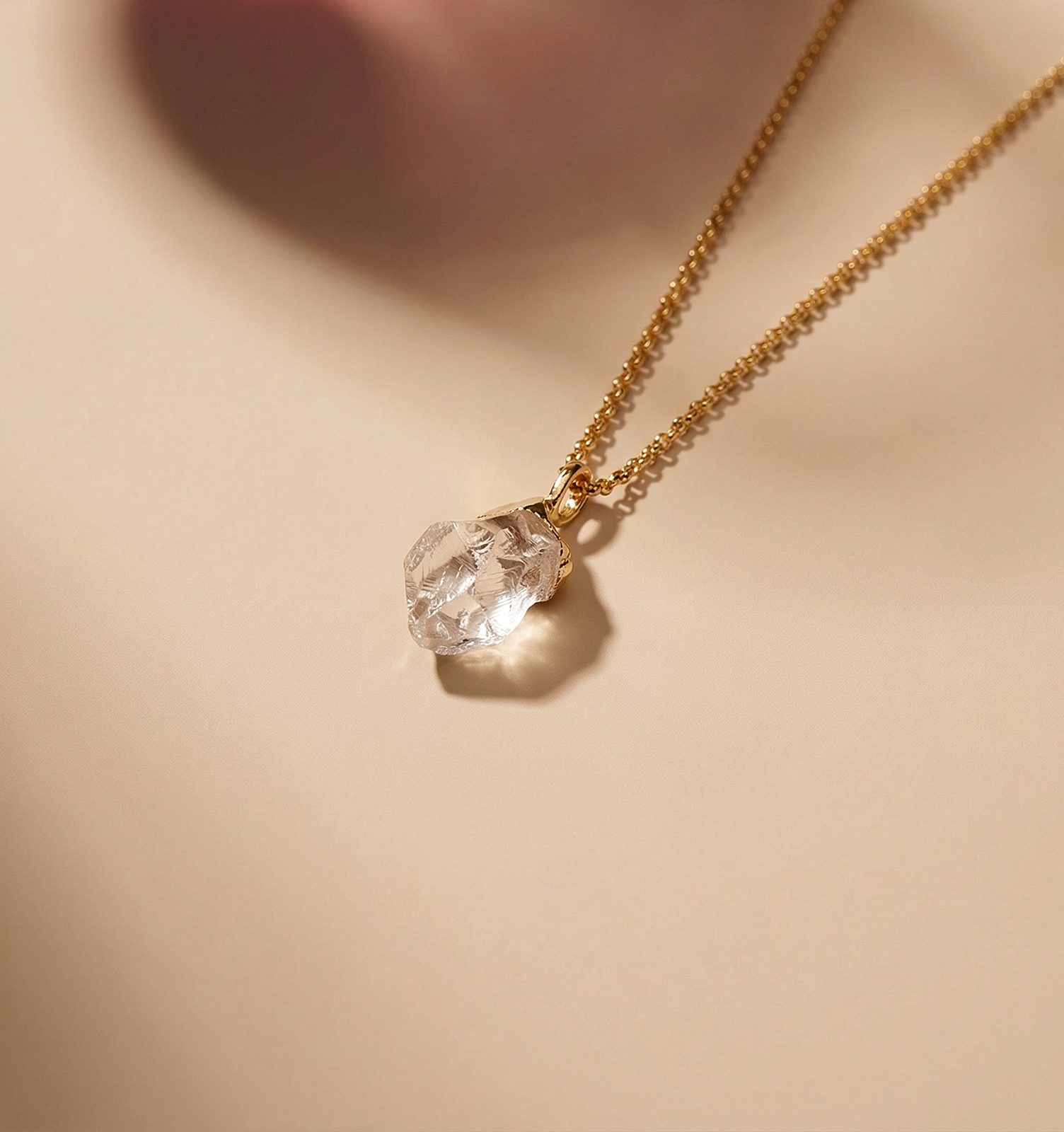
AI Jewelry Photography: Keep the Product Real, Generate the Rest
Generative AI will happily draw you a diamond. It will also happily lie about it. The profitable move is knowing exactly which half of your photography to hand over.
Here is the claim, stated plainly so you can hold us to it: generative AI cannot photograph your stone, and it will not be able to for a while, because a faceted gemstone is close to a worst-case object for image models. Everything else in your visual pipeline, the backgrounds, the cleanup, the scene, the scale, the volume, is now cheaper and faster with AI than without it. Jewelers keep getting this backwards: they use AI to prettify the product and humans to fuss over backgrounds, when the winning setup is the exact opposite.
Why Generative AI Cannot Photograph a Diamond
AI jewelry photography works when AI handles the context around a real photograph of the piece, and fails when it generates the piece itself. The reason is physics, not software maturity. A cut stone is a hall of mirrors: dozens of facets bouncing light into each other, fire and brilliance that depend on exact angular geometry, and a metal setting reflecting the whole room back at the camera. Diffusion models do not compute optics; they paint plausible pixels. Plausible is precisely what a $3,000 ring cannot afford to be, because the sparkle pattern a model invents belongs to no real stone, and the delivered ring will not match it.
The same logic condemns the softer sin: the “enhance” slider that adds brilliance to a real photograph. A stone’s fire and brightness are not decoration, they are the visible evidence of cut quality, and cut quality is priced. Brighten a mediocre make into a photograph of an excellent one and you have not improved an image, you have implicitly regraded the stone upward and charged for it. That is why the argument here is not anti-AI squeamishness; it is the recognition that in this category, optical behavior is product specification, and specification is not a creative surface.
The Details Buyers Actually Zoom Into
Watch anyone shop fine jewelry online and the behavior is consistent: zoom on the stone, zoom on the prongs, zoom on the clasp. Those 3 zoom targets are exactly where generated imagery falls apart: facet junctions that merge, prongs that count 5 on one side and 4 on the other, hallmark text that dissolves into noise. In apparel, a slightly reinterpreted knit texture survives; a slightly reinterpreted pavé does not, because in this category the macro detail is the product. The shot list logic in our jewelry product photography pillar exists precisely because those macro and detail slots do the selling: gallery order is persuasion, and the zoomable shots are the closing argument. Hand those particular slots to a generator and you have put your least honest image at the exact moment of highest scrutiny.
A Return Is a Failed Photograph
Jewelry already carries the burden of being bought unseen at emotional price points, and the photograph is the contract. When the delivered piece reads smaller, duller, or yellower than the gallery, the customer does not file it under artistic license, she files a return and remembers the brand as the one that oversold. An AI-generated stone raises exactly that risk with no offsetting upside, since the honest alternative, photographing the real piece well once, is a solved problem. Spend where the risk is, save where it is not.
Where AI Jewelry Photography Actually Wins
Having drawn the line at the stone, put AI to work everywhere on the safe side of it. The piece in every image below is a real photograph of the real product; what AI changes is the world around it, the model wearing it, and the number of versions you can ship. The wins below are open to a single-bench operation, not only to chains, and they all run on the same fuel: a correct source capture of the actual piece.
Backgrounds and Still-Life Scenes
Shoot the piece once on neutral ground, then let AI place that untouched photograph on travertine, on velvet, in a sunlit vignette for the holiday email, in a flat-lay context for social. The product pixels never change; the world around them does. This is the single highest-leverage move for a small jewelry brand, because it converts one capture session into a season of channel-specific imagery, the same catalog-to-campaign logic we lay out in the AI product photography playbook, applied to the category where product fidelity matters most.
The craft detail that separates a composite from an obvious paste-job is light agreement. A piece shot under soft top light dropped into a scene with hard side light reads wrong before the customer can say why, and mismatched shadow color does the same quiet damage. So brief the capture with the destinations in mind: keep the lighting neutral and diffuse, keep the raw files, and when you generate the scene, match its light direction to the light that actually hit the metal. Get that right and the composite survives scrutiny; get it wrong and no amount of resolution saves it.
Lifestyle: The Real Piece, On a Real Model, Multiplied
Still-life places the piece in a world; lifestyle puts it on a person, and for jewelry that difference is where conversions are decided. A necklace on a collarbone, earrings that catch a turn of the head, a ring on a hand mid-gesture answer the question every product page struggles with, “how will this look on me,” and they answer it better than any flat-lay because the customer sees the piece worn. The win is real and it is large, and it does not require inventing anything. Shoot the actual piece on an actual model once, capture it cleanly from the angles that matter, and AI takes that real on-model frame and multiplies it: new backgrounds, new outfits, new seasons, new crops, one shoot becoming a summer campaign, a holiday email, and a paid-social set with no second booking.
The quality condition here is the whole game, and it is worth stating plainly, because it is where cheap tools fail and where the work earns its keep. The jewelry is never generated; it is always the real photographed piece. The body is real too, because generated hands, ears, and necklines remain the most visible tell in image models, and a subtly wrong finger under a real ring erases the credibility the shot exists to build. And the scale stays true, since size disappointment is a top driver of jewelry returns. Feed the model the right source material, a correct multi-angle capture of the real piece at true proportion, and AI will place that piece on a model, at scale, looking right. Feed it a guess and it returns a guess. Correct inputs are the entire difference between a lifestyle library that sells and one that manufactures returns, and producing those inputs properly is the discipline this whole pipeline is built on.
The Working Rhythm: Batch Capture, Then Multiply
Put the pieces together and a small brand’s operating rhythm looks like this: one capture day per collection, every piece trayed and shot in a standardized setup (a turntable lightbox rig of the GemLightbox class, or a bench-built equivalent with the same repeatability), files named by SKU. Then the batch pass: background removal, cleanup, and normalization across the whole set in an afternoon rather than a week. The seasonal work happens on the calendar’s schedule, not the studio’s: before Valentine’s Day, before Mother’s Day, before the holiday window, the same untouched captures get new generated scenes and fresh channel crops. The piece is photographed once a year; the imagery around it turns over 4 or 5 times. That rhythm was structurally unavailable to independent jewelers 3 years ago, and it is the practical answer to competing with chains that have studios on retainer.
Ad Variants: One Hero Frame, a Whole Media Plan
The place this pays back hardest is paid media, because performance advertising is hungry for variety. A campaign wants many versions to test against each other: different formats for different placements, different backgrounds, seasonal hooks, audience-specific framings, each one pruned by what actually converts. Producing that range the old way meant reshoots; producing it from a single clean hero capture plus AI context is the difference between running 3 ad creatives and running 30, all built on the same real piece. The jewelry is photographed once; the ad set it feeds is effectively unlimited, and that tested volume is where the cost math of the whole pipeline turns into return.
Seeing It On: Try-On and Scale
The oldest conversion problem in online jewelry is “how will it look on me,” and AI-adjacent tech has been chipping at it since before the current wave: Kendra Scott shipped an AR try-on for earrings back in May 2020, built with AR firm Mirelz, starting with earrings deliberately because they move with the wearer (JCK). The honesty rule carries over unchanged: a try-on that renders the piece at inflated size or exaggerated brilliance is a return generator wearing a technology costume. Scale must be true, or the feature works against you.
Short of a full try-on build, scale still deserves deliberate treatment, because size disappointment drives a painful share of jewelry returns and it is entirely preventable with photography. Do 3 things. State the millimeter dimensions on the product page, in the copy, where no rendering can distort them. Keep a true-scale reference shot in the gallery: the piece photographed against a ruler or a familiar-size object, so absolute size reads at a glance and not just relative proportion. And use real on-body shots as the final scale evidence, because a piece worn on a hand or a neck is where a customer actually judges size. That last one is exactly where AI tends to fail: seating jewelry on a model at true scale is one of the hardest things in this whole discipline to get right, and most generators quietly render the piece bigger and more flattering than it ships. If your current AI vendor cannot place the piece on a model at honest scale, do not let it try; use real photography for those frames, or bring them to us, because getting real jewelry onto real people at true scale is precisely what our pipeline is built to do. And if you do composite onto a model, composite onto a photographed one: generated hands and ears remain a known weak spot, and a subtly wrong hand undermines the exact credibility the scale shot exists to provide.
The Trust Line: The Rule That Decides Every Call
Every AI decision in jewelry imaging reduces to a single question: does the image honestly represent the physical piece the customer will receive? Enhancing a real photograph, cleaning it, relighting it within reason, placing it in a generated scene, stays on the right side of that line. Generating or altering the piece itself, so that the image shows a product that does not exist, crosses it. In most categories crossing the line costs you a return; in jewelry it costs you the thing the whole business runs on, because nobody buys a second engagement ring from the store that misrepresented the first. Write the rule into your workflow literally: product pixels are read-only.
Disclosure: Mark What You Generate
Whatever the pipeline generates still needs to be disclosed, and the duty attaches to any AI element in the frame. In the EU, transparency obligations under the AI Act start applying on August 2, 2026, and in the US the FTC can already act against a misleading image under its deception authority. The states are moving faster than Washington: New York’s SB 8420-A is the first to require a clear label on synthetic performers in advertising, effective June 9, 2026, and California’s AI Transparency Act (SB 942) follows on August 2, 2026. Treat New York as the precedent rather than the exception, and expect the rest to follow. Mark generated elements like any other AI asset, disclose synthetic people wherever they appear, and keep the piece itself real in every frame that sells it (the full legal picture is in the flagship playbook).
Playing With Scale: The Surreal Campaign Frame
The trust line forbids faking the stone, but it says nothing against building an impossible world around a real one, and for a jewelry brand that is a genuine creative opening. The move fashion and beauty made famous, a real product placed at surreal scale in a world that could not exist, works for jewelry too: a real ring the size of a monument, a real necklace draped across an impossible landscape, a pendant orbiting like a planet. Jacquemus did it with giant handbags rolling through Paris and Maybelline with mascara wands sweeping along London buses, both real products in built, oversized worlds (Paper).
The jewelry version obeys the same split that governs everything else here: the piece is the real photographed piece, captured accurately, and only the scale and the setting are generated. The honesty is in the placement. This is a campaign and social asset, a mood frame that sells the brand’s imagination, not a product-page image and never a substitute for the accurate shots a buyer zooms into. Used there, surreal scale is pure upside, because no customer mistakes a ring the size of a building for a promise about millimeters. The move once demanded a CGI budget; AI now brings the still-frame version within reach of an independent jeweler, while the hardest physics still belongs to CGI.
Where the Line Sits for Your Store
Rules only work when they leave your head and enter the brief, because the person who violates the trust line is rarely you: it is the freelancer batch-processing your catalog at midnight, the marketplace tool offering to “enhance” your listings, the intern with a generator subscription and good intentions. Translate all of the above into a working split, write it into every production brief, and hold vendors to it in the contract:
- Photograph for real, always: hero shots, angles, macro and detail, scale reference, anything a customer can zoom, and any image attached to a specific SKU.
- Automate freely: background removal and replacement, dust and reflection cleanup, catalog-wide color and lighting normalization, format versioning for channels.
- Generate freely: non-SKU brand imagery, campaign moods, seasonal scenes your real photographs sit inside.
- Never: generated stones on product pages, AI-added sparkle, try-on renders at flattering scale, or any image you could not defend next to the open box.
That split is easy to state and genuinely annoying to run, because it demands real photography discipline and AI production discipline in the same pipeline at the same time. Most brands can hold one or the other. The reason the AI half is so much harder than it looks, in this category specifically, is worth understanding before you hand it to anyone.
Why Good Jewelry AI Photography Is So Rare
Everything above assumes the AI production is done well. In jewelry, done well is the exception, because 4 structural problems stack on top of each other, and each one is a property of how image models work rather than a bug the next software update will fix. This is why the tools demo so beautifully and disappoint so specifically: the sizzle reel is a matte sneaker on a clean background, and your inventory is a pavé halo that reflects the room. Understand the 4 and you stop mistaking a good demo for a solved problem.
Problem 1: The Models Are Trained on Matte, and Jewelry Is Gloss
This is the core one, and it explains most of the rest. Image models learn from enormous sets of web photographs that are overwhelmingly matte and diffuse: skin, fabric, food, faces, rooms, landscapes. Specular metal and refractive faceted stones are both rare in that training data and physically the hardest surfaces in the world to reproduce, because their appearance is almost entirely reflection and refraction. Polished gold mostly shows you the room around it; a diamond is bending light through precise angles rather than having a color of its own. A model built on matte priors approximates all of that with generic highlights that sit in the wrong places, so real gold starts to read like plastic and a real stone like a molded glass bead. Everything that makes jewelry look expensive lives in exactly the optical behavior these models handle worst.
Problem 2: Geometry It Cannot Actually Count
A setting is micro-architecture: a specific prong count, a gallery, a basket, the exact seat of the stone, the symmetry of a halo. Image models reason toward plausible shapes, not engineering drawings, so they drift, turning 6 prongs into 5, tilting a halo off-axis, merging claws that should be distinct. A wrinkle in a shirt can fall a hundred different ways and nobody notices; a 6-prong setting rendered with 5 prongs is a different product, and in fine jewelry the geometry is the design and a real part of the price.
Problem 3: No Sense of True Scale
The model renders “a ring” with no idea whether the band is 2mm or 8mm, whether the center stone is a third of a carat or 3 carats. Absolute size is precisely the property it does not encode, so proportion drifts, most visibly the moment the piece sits against a hand or a neck. That connects straight back to the returns argument earlier in this piece: an image that renders the piece larger than it arrives is the single most reliable way to manufacture a disappointed unboxing and a refund.
Problem 4: It Will Not Hold the Same Piece Twice
Generation works by sampling, and sampling varies, so ask a general model for the same ring twice and you get 2 rings that are cousins, not the same piece. Run a catalog through it and you do not get your product line, you get a family reunion of things that resemble your product line. That is disqualifying, because a single SKU has to look identical across its product page, its ads, and its email, and a campaign’s hero piece has to be that exact piece in every frame. Non-repeatability breaks the one thing a brand identity depends on: that the product you are selling is recognizably itself, everywhere it appears.
Why No Turnkey Tool Solves This
These 4 problems do not add, they multiply, and together they explain a market fact you can confirm in an afternoon of testing: no off-the-shelf or turnkey jewelry-AI tool produces genuinely good generations, because every one of them sits on top of a general model carrying those general matte, approximate, and inconsistent priors. The only real alternative is to build your own capability, training or fine-tuning a model on a large and correct jewelry dataset until it actually learns gloss, geometry, scale, and identity. That is an enormous investment of time and money, and, hardest of all, of data that almost nobody possesses. Which is why, told honestly, we have yet to see a single jewelry brand stand up a working in-house generation pipeline of its own. The problem is real, it is expensive, and across the category it remains mostly unsolved.
What Tuple Built to Solve It
This is the specific problem Tuple Strategy set out to solve, and the reason we could is a partnership. Tuple is a longtime partner of LenFlash, a jewelry-photography studio that holds among the largest proprietary datasets of jewelry imagery anywhere. On that foundation we built our own methodology and fine-tuned a model specifically for jewelry, so that a real captured piece keeps its specular truth, its geometry, its true scale, and its identity across every generated scene, model, season, and ad variant, the 4 places general tools come apart. And it holds the thesis of this entire article in place, because it works only from source material captured the right way. Right inputs, right output; feed it a guess and it hands you back a guess. If you sell jewelry and you want AI production that respects the piece instead of reinventing it, bring Tuple Strategy your collection and the way you shoot it, and we will build the rest.