
The Conversion Engine: How AI Became Fashion’s Most Important Growth Lever in 2026
For most of the last decade, fashion eCommerce treated AI as a content problem, something to write the product copy faster, auto-tag the catalog, or power a chatbot that mostly annoyed people. It was useful at the edges and easy to ignore.
That framing is finished. The brands pulling ahead in 2026 have stopped asking what AI can write and started asking what it can convert, and the difference between those two questions is now worth tens of millions of dollars. The receipts landed in June 2026.
The Problem AI Actually Solves
Start with the number nobody likes to say out loud. Luxury eCommerce converts at roughly 0.7% to 0.8%, and high-ticket handbags closer to 0.5%, according to the Business of Fashion analysis of the DressX report. For every thousand people who reach a product page, 5 or 6 buy, and the rest leave, not because they can’t afford it but because they can’t picture it. They can’t tell how a jacket actually fits, how the fabric falls, or whether a $2,000 decision made on a phone screen is the right one.
That hesitation is the most expensive thing in fashion eCommerce, and it is exactly where this year’s money is going. Not the top of the funnel, where brands already spend freely, but the last few inches before checkout, the moment of doubt that decides everything.
Virtual Try-On Cracks the Confidence Gap
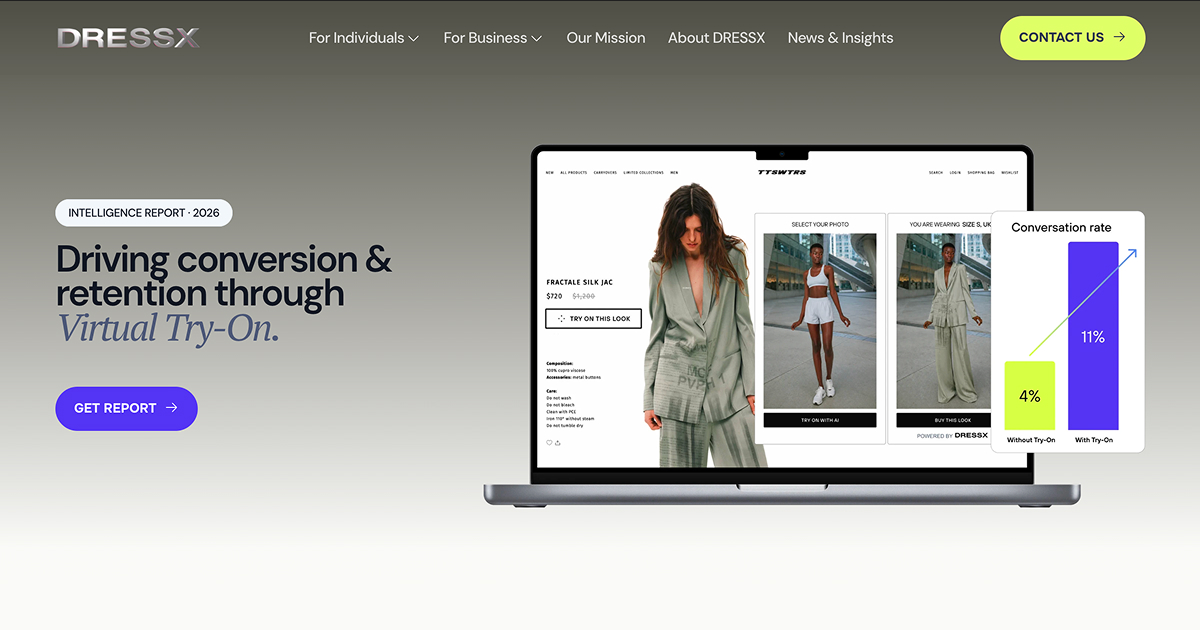
The clearest proof arrived in June 2026 in a DressX intelligence report, analyzed by Business of Fashion and built on more than 1 million shoppers across luxury platforms. The headline finding is hard to argue with: shoppers who use AI virtual try-on are 50% more likely to buy, and among luxury consumers specifically, conversion runs up to 10 times higher than for shoppers who never touch the tool. Against a 0.7% baseline, that isn’t an optimization; it’s a different business.
The mechanics underneath are just as telling. Try-on users were roughly 3 times more likely to add to cart, viewed about 7 times as many products, and came back more often after the first visit. The tool doesn’t just close a single sale, it changes how people shop, getting them to explore more, return more, and buy with more confidence. DressX also reports return rates falling by up to 40% in some categories, which matters a great deal when US retailers absorbed roughly $850 billion in returned merchandise in 2025, per the National Retail Federation.
The technology matured off to the side while everyone was watching generative text. DressX’s Agent, launched in late 2025, lets a shopper build a digital twin from a single selfie and try on items from more than 200 luxury brands, checking out on the retailers’ own sites including Mytheresa, SSENSE, and Farfetch. The fitting room isn’t dead, but it has stopped being the place where the expensive decision actually gets made. For anyone selling considered purchases online, the lesson is simple: visual confidence is now a conversion lever you can measure, not a nice-to-have.
Personalization Moves From Campaign to Flywheel
If try-on fixes the product page, the second front is the marketing itself, and the most instructive move came from Gap Inc., unveiled at Cannes Lions and reported by WWD. Gap is rebuilding its owned marketing on Zeta Global’s AI Marketing Cloud, which unifies customer signals like purchases and clicks, generates insights, and fires personalized messaging across email and paid media. Its agent, Athena, handles audience building, campaign setup, creative, simulation, and QA conversationally, compressing the kind of work that used to eat a team’s week into a single prompt. Underneath it all sits a unified data foundation built on Google Cloud’s Gemini, Agent Studio, and Agent Engine.
The phrase worth stealing is Gap’s own. They describe the shift as moving from “a linear, campaign-based marketing model to an AI-enabled marketing flywheel,” an always-on system where content, activation, commerce, and data feed each other continuously. “This transformation brings together data, AI and agentic capabilities to help us better understand customer intent [and] move faster,” said CTO Sven Gerjets.
Campaign to flywheel is the real story here. Most brands still run marketing in bursts, planning and launching and measuring and repeating, while the emerging model treats every customer interaction as a live input that reshapes the next one on its own. You don’t need Gap’s budget to adopt the posture; you need clean customer data and the willingness to let the system learn.
The New Storefront Is a Conversation
The third front is the newest and the least understood, and it is the one most brands haven’t noticed yet: shopping is migrating off the search bar and into AI assistants. Gap became the first major fashion company to put instant checkout inside Google’s Gemini, per CNBC, using Google’s Universal Commerce Protocol so customers can buy directly while searching in AI Mode, and it paired that with Bold Metrics’ predictive sizing to drop fit guidance into the conversation at the exact moment of purchase.
This is agentic commerce, and it is still very much a first draft; Gerjets himself called it “a very first experience in a journey we’re all on.” The direction, though, is not subtle. As discovery shifts from Google’s blue links to AI answer engines, the brands that show up transaction-ready inside those conversations will catch demand the rest never see, and the uncomfortable flip side is that if your product data isn’t structured for machines to read and act on, you go invisible at the precise moment a buyer is ready.
Digital and Physical, Compounding

None of this means screens replace stores. The most disciplined operators wire the two together, with AI as the connective tissue, and Aritzia is the cleanest example. The brand grew fiscal 2026 revenue 35% to $3.7 billion, with US revenue up nearly 44%, and credits an interlocking digital and physical model for the lift. As Glossy reports, opening a boutique in a new market like St. Louis produces a “strong and sustained lift” in regional digital sales in the high double digits, according to chief digital officer Margot Johnson.
The engine on the digital side is personalization. Aritzia’s app, launched in late October, passed a million downloads within weeks and quickly became a key driver of its eCommerce growth. Its “eCommerce 2.0” strategy rests on 3 connected ideas, tailored discovery through personalization, creative innovation, and a frictionless experience across touchpoints, and the logic is clean: the store creates the awareness, and AI-powered personalization converts it.
What This Means for Your Brand
The pattern across all three fronts is the same. AI’s real payoff in 2026 isn’t efficiency, it’s conversion, and it works on the doubt that kills sales at the moment of decision. What separates the brands capturing this from the ones watching it happen comes down to 3 moves.
The first is to treat the product page as a confidence problem. Visual try-on, predictive fit, and richer product context aren’t gimmicks; they move the one number that decides whether traffic becomes revenue, and even a modest lift against a sub-1% baseline changes the shape of the business.
The second is to shift from campaigns to a flywheel. Unify your customer data first, then let AI personalize continuously instead of in scheduled bursts, because the advantage compounds, and the brands that wait will be learning from a smaller, staler dataset every quarter.
The third is to make your catalog machine-readable now. Agentic commerce is early, but the brands structuring their product data for AI assistants today will own the conversation when buyers stop typing URLs and start asking.
The DTC era taught brands to buy traffic. The AI era is teaching them something harder and more valuable, which is how to convert the traffic they already have. The tools are no longer experimental and the data is no longer ambiguous, so the only question left is who moves first.