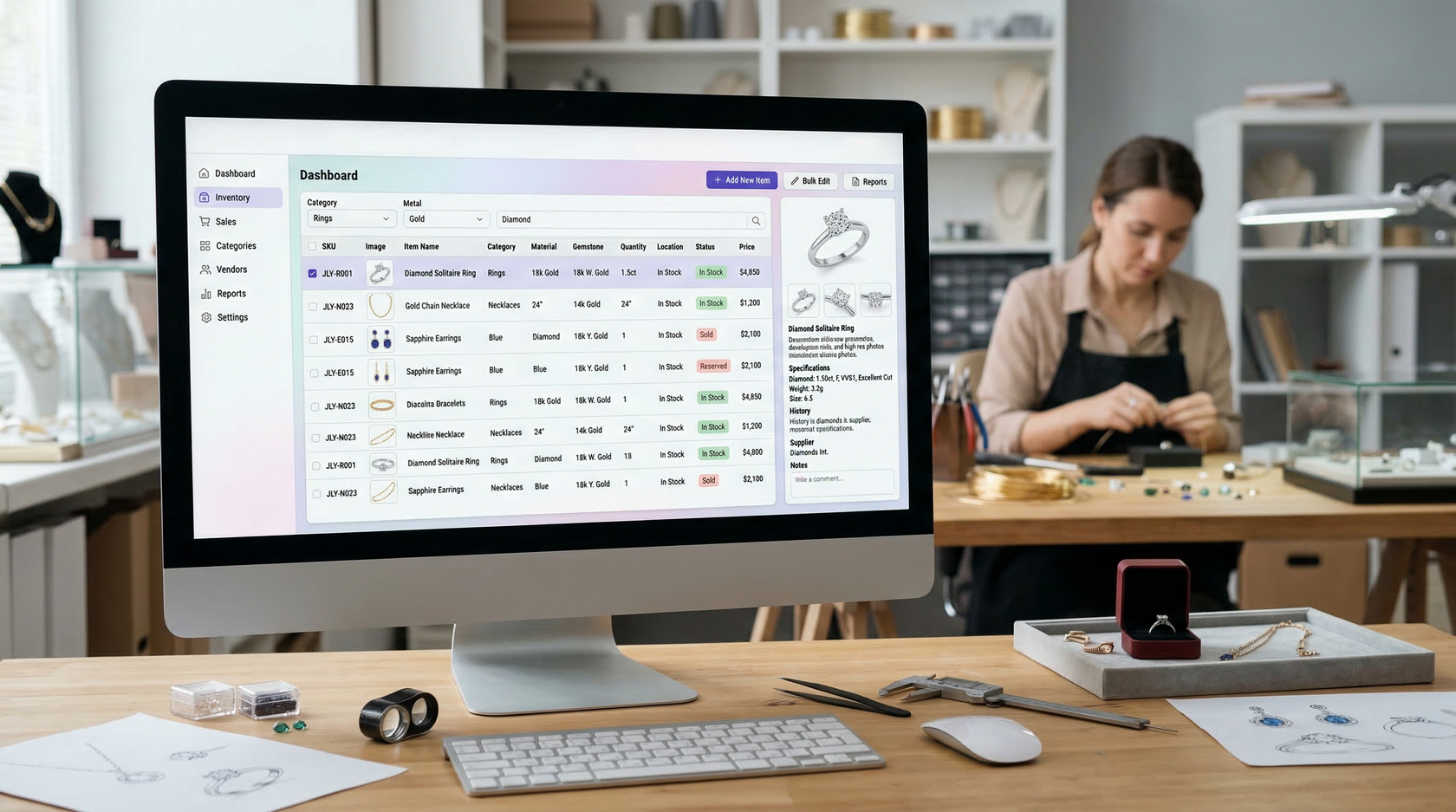
Sarah runs a successful jewelry business generating $800K annually, but she was drowning in inventory chaos. Custom orders disappeared into production black holes, her bestselling rings were always out of stock during peak seasons, and she had $50K sitting in slow-moving pieces she couldn't move. Sound familiar?
Six months later, Sarah's inventory practically runs itself. She knows exactly what's selling, when to reorder, and how much cash she has tied up in each category. Customer complaints about availability dropped to nearly zero, and she freed up $20K in working capital by clearing out dead inventory strategically.
The difference wasn't magic or massive software investments. Sarah learned what successful jewelry entrepreneurs have discovered: effective inventory management follows predictable systems that any growing business can implement without breaking the bank or disrupting operations.
Six months later, Sarah's inventory practically runs itself. She knows exactly what's selling, when to reorder, and how much cash she has tied up in each category. Customer complaints about availability dropped to nearly zero, and she freed up $20K in working capital by clearing out dead inventory strategically.
The difference wasn't magic or massive software investments. Sarah learned what successful jewelry entrepreneurs have discovered: effective inventory management follows predictable systems that any growing business can implement without breaking the bank or disrupting operations.
Why Jewelry Inventory Management Feels So Complicated
Your jewelry business faces unique challenges that Amazon and Target never deal with. Gold prices change daily, affecting your costs and margins. Custom pieces take weeks to complete with multiple approval stages. Customers expect to see your signature pieces in stock immediately, but you can't predict which designs will suddenly take off on social media.
One jewelry business owner told us, "I thought I could wing it with spreadsheets until I accidentally promised the same engagement ring to two different customers. That was my wake-up call."
Unlike selling t-shirts or coffee mugs, jewelry inventory requires tracking precious metals pricing, gemstone specifications, work-in-progress pieces, and finished goods with serial numbers or custom details. Miss any piece of this puzzle and you either disappoint customers or tie up cash in inventory that doesn't sell.
The good news? You don't need enterprise-level complexity to solve these problems. Most jewelry businesses succeed with surprisingly simple systems once they understand the basics.
One jewelry business owner told us, "I thought I could wing it with spreadsheets until I accidentally promised the same engagement ring to two different customers. That was my wake-up call."
Unlike selling t-shirts or coffee mugs, jewelry inventory requires tracking precious metals pricing, gemstone specifications, work-in-progress pieces, and finished goods with serial numbers or custom details. Miss any piece of this puzzle and you either disappoint customers or tie up cash in inventory that doesn't sell.
The good news? You don't need enterprise-level complexity to solve these problems. Most jewelry businesses succeed with surprisingly simple systems once they understand the basics.
The 30-Day Quick Win: Stop the Bleeding First
Before building sophisticated systems, address the inventory problems that are costing you money right now. Based on our experience with jewelry businesses, these three issues cause 80% of inventory headaches:
Week 1: Find Your Missing Inventory
Almost every jewelry business we've worked with discovers thousands of dollars in "lost" inventory during their first audit. Pieces sitting in repair drawers, samples that never made it back to display cases, or work-in-progress items forgotten in workshop corners.
Your action plan:
One client found $15K worth of inventory that wasn't being offered for sale because it was scattered across three locations with no tracking system.
Your action plan:
- Physically count everything in your business
- Create a simple spreadsheet with: Item description, location, estimated value, status (for sale, repair, sample, etc.)
- Take photos of everything - this becomes your baseline
One client found $15K worth of inventory that wasn't being offered for sale because it was scattered across three locations with no tracking system.
Week 2: Identify Your Cash Vampires
Look through your inventory and identify pieces that have been sitting for more than six months without generating interest. These "cash vampires" drain your working capital without providing returns.
Your action plan:
A successful jewelry business owner shared, "I had $25K sitting in pieces I thought were beautiful but customers weren't buying. Once I accepted this and cleared them out, I had cash to invest in pieces that actually sold."
Your action plan:
- Mark items by purchase/completion date
- Calculate how much money is tied up in slow-moving pieces
- Set aside obvious non-movers for clearance pricing
A successful jewelry business owner shared, "I had $25K sitting in pieces I thought were beautiful but customers weren't buying. Once I accepted this and cleared them out, I had cash to invest in pieces that actually sold."
Week 3: Create Your Bestseller List
Identify your top 20 pieces by revenue and profit contribution. These items should never be out of stock, and you should understand exactly how long it takes to replenish them.
Your action plan:
Your action plan:
- Calculate total revenue per piece type over the last 12 months
- Note current stock levels and reorder lead times
- Set minimum stock levels that prevent stockouts
The Simple Software Solution That Actually Works
You don't need $500/month specialized jewelry software to solve inventory problems. Most successful jewelry businesses under $2M annual revenue use surprisingly basic tools effectively rather than complex systems poorly.
Option 1: The Spreadsheet Pro Method (Free - $10/month)
Google Sheets or Excel can handle sophisticated jewelry inventory when set up correctly. This works well for businesses with under 500 SKUs and straightforward operations.
What you track:
Pro tip: One jewelry business owner created dropdown menus for locations, categories, and vendors. "It takes 30 seconds to update when something sells, and I always know exactly what I have."
What you track:
- SKU, description, location, quantity, cost, retail price
- Vendor information and reorder quantities
- Sales velocity (units sold per month)
- Last sold date and total revenue generated
Pro tip: One jewelry business owner created dropdown menus for locations, categories, and vendors. "It takes 30 seconds to update when something sells, and I always know exactly what I have."
Option 2: Professional Inventory Software ($50-200/month)
When spreadsheets become unwieldy (usually around 500+ pieces or multiple locations), dedicated software provides better organization and automation.
What to avoid: Don't buy specialized jewelry software until you're doing $2M+ annually. Most features you won't use, and the complexity often creates more problems than it solves.
Option 3: The Hybrid Approach
Many successful jewelry businesses use simple software for basic tracking while maintaining detailed spreadsheets for specific analyses like precious metals costs or custom order management.
As one business owner explained, "I use Lightspeed for daily operations and sales, but I still track precious metals costs in a spreadsheet because I can update pricing instantly when gold moves."
As one business owner explained, "I use Lightspeed for daily operations and sales, but I still track precious metals costs in a spreadsheet because I can update pricing instantly when gold moves."
Physical Storage That Doesn't Require a Vault
Professional jewelry storage doesn't require bank-level security systems. Focus on organization and basic security that insurance companies accept while keeping costs reasonable.
The Three-Zone System
Organize physical storage into three zones based on access frequency and security requirements:
Zone 1: Daily Access (Display and frequent pieces)
Zone 2: Weekly Access (Backup stock and moderate value)
Zone 3: Monthly Access (High value and slow movers)
One jewelry business owner shared her approach: "I keep $20K worth of inventory accessible for immediate customer viewing. Everything else goes in organized storage by category. Customers never wait more than five minutes for me to retrieve something."
Zone 1: Daily Access (Display and frequent pieces)
- Professional display cases with basic locks
- Items under $2,000 that customers expect to see immediately
- Easy access for staff but secure from customer reach
Zone 2: Weekly Access (Backup stock and moderate value)
- Locking drawers or small safes rated for jewelry
- Insurance companies usually require basic fire resistance
- Items $2,000-$10,000 or pieces needed occasionally
Zone 3: Monthly Access (High value and slow movers)
- Professional safe meeting insurance requirements
- Items over $10,000 or pieces rarely accessed
- Bank safety deposit boxes for extremely valuable pieces
One jewelry business owner shared her approach: "I keep $20K worth of inventory accessible for immediate customer viewing. Everything else goes in organized storage by category. Customers never wait more than five minutes for me to retrieve something."
Organization Systems That Work
Color-coded trays: Different colors for different categories (rings, necklaces, earrings, etc.). "My staff can find anything in under a minute because everything has a designated spot."
Size-based compartments: Adjustable dividers accommodate different piece sizes while preventing damage from pieces banging together.
Digital photos with storage: Take photos of storage areas so you can tell customers what's available without physical access.
Size-based compartments: Adjustable dividers accommodate different piece sizes while preventing damage from pieces banging together.
Digital photos with storage: Take photos of storage areas so you can tell customers what's available without physical access.
The 90-Day Complete System Implementation
Transform your inventory management systematically without disrupting daily operations:
Month 1: Foundation (Weeks 1-4)
Week 1: Complete physical inventory audit and create baseline documentation
Week 2: Implement basic tracking system (spreadsheet or simple software)
Week 3: Organize physical storage using three-zone system
Week 4: Train team on new procedures and create backup protocols
Week 2: Implement basic tracking system (spreadsheet or simple software)
Week 3: Organize physical storage using three-zone system
Week 4: Train team on new procedures and create backup protocols
Month 2: Optimization (Weeks 5-8)
Week 5: Analyze sales patterns and establish reorder points
Week 6: Implement vendor coordination and ordering schedules
Week 7: Create customer communication systems for special orders
Week 8: Develop financial tracking and profitability analysis
Week 6: Implement vendor coordination and ordering schedules
Week 7: Create customer communication systems for special orders
Week 8: Develop financial tracking and profitability analysis
Month 3: Advanced Features (Weeks 9-12)
Week 9: Add forecasting based on seasonal patterns
Week 10: Implement customer preference tracking
Week 11: Create automated reorder alerts and vendor coordination
Week 12: Develop reporting systems for strategic decision-making
Week 10: Implement customer preference tracking
Week 11: Create automated reorder alerts and vendor coordination
Week 12: Develop reporting systems for strategic decision-making
Common Mistakes That Cost Money
Learn from these expensive mistakes other jewelry business owners have made:
The "Everything is Special" Trap
Treating every piece like it requires unique handling creates unnecessary complexity. "I was tracking 47 different data points for each piece until I realized I only actually used five of them for decisions," shared one business owner.
Solution: Track only information that affects decisions. Start simple and add complexity only when you have specific needs.
Solution: Track only information that affects decisions. Start simple and add complexity only when you have specific needs.
The Technology Overkill Problem
Buying expensive specialized software before understanding your actual needs often creates more problems than it solves. "I spent $800/month on jewelry software that took six months to set up properly. I could have solved 90% of my problems with a $60/month solution."
Solution: Start with simpler tools and upgrade only when you hit specific limitations that justify additional complexity.
Solution: Start with simpler tools and upgrade only when you hit specific limitations that justify additional complexity.
The Perfect System Paralysis
Waiting for the "perfect" system prevents you from solving problems with good enough solutions that work today. "I spent eight months researching software while my inventory problems got worse every day."
Solution: Implement simple improvements immediately while planning longer-term system development.
Solution: Implement simple improvements immediately while planning longer-term system development.
The "Set It and Forget It" Mistake
Inventory management requires ongoing attention and adjustment. Systems that aren't maintained regularly become unreliable and eventually useless.
Solution: Schedule weekly 30-minute inventory reviews and monthly system optimization sessions.
Solution: Schedule weekly 30-minute inventory reviews and monthly system optimization sessions.
Real Numbers: What Good Inventory Management Delivers
Successful jewelry businesses see measurable improvements from systematic inventory management:
Stockout reduction: 60-80% fewer customer disappointments due to unavailable items
Cash flow improvement: 15-25% reduction in inventory carrying costs through better optimization
Time savings: 5-10 hours per week saved on inventory-related tasks
Sales increase: 10-20% revenue growth from better availability and customer service
Stress reduction: Immeasurable improvement in business owner peace of mind
One jewelry business owner summarized her results: "I used to dread inventory management. Now it's just part of my routine, and I sleep better knowing exactly what I have and what I need to order."
Stockout reduction: 60-80% fewer customer disappointments due to unavailable items
Cash flow improvement: 15-25% reduction in inventory carrying costs through better optimization
Time savings: 5-10 hours per week saved on inventory-related tasks
Sales increase: 10-20% revenue growth from better availability and customer service
Stress reduction: Immeasurable improvement in business owner peace of mind
One jewelry business owner summarized her results: "I used to dread inventory management. Now it's just part of my routine, and I sleep better knowing exactly what I have and what I need to order."
Managing Custom Orders Without Losing Your Mind
Custom orders create the biggest inventory headaches for most jewelry businesses. You're juggling materials, timelines, customer approvals, and production schedules while trying not to promise pieces you can't deliver.
Here's how successful jewelry business owners handle custom work systematically:
Here's how successful jewelry business owners handle custom work systematically:
The Simple Custom Order Tracking System
Step 1: Create a Custom Order Status Board
Use a simple system to track each custom piece through production stages:
One jewelry business owner uses a physical whiteboard: "Each custom order gets a card that moves across columns. My whole team can see exactly where everything stands."
Step 2: Materials Reservation System
Reserve materials for custom orders immediately when you accept the project. This prevents the nightmare of promising a custom piece, then discovering you don't have the required gold or gemstones.
"I learned this the hard way," shared a business owner. "I promised a custom engagement ring, then gold prices jumped and my supplier was out of the specific diamonds I needed. Now I physically set aside materials when I take the deposit."
Step 3: Customer Communication Schedule
Establish regular check-in points rather than waiting for customers to ask for updates:
"Proactive updates prevent 90% of customer anxiety calls," noted one successful business owner.
Use a simple system to track each custom piece through production stages:
- Ordered: Customer deposit received, specifications confirmed
- Materials Sourced: All components acquired and reserved
- In Production: Actively being created in workshop
- Customer Review: Awaiting customer approval or feedback
- Final Production: Completing after approval
- Ready for Pickup: Finished and awaiting customer
One jewelry business owner uses a physical whiteboard: "Each custom order gets a card that moves across columns. My whole team can see exactly where everything stands."
Step 2: Materials Reservation System
Reserve materials for custom orders immediately when you accept the project. This prevents the nightmare of promising a custom piece, then discovering you don't have the required gold or gemstones.
"I learned this the hard way," shared a business owner. "I promised a custom engagement ring, then gold prices jumped and my supplier was out of the specific diamonds I needed. Now I physically set aside materials when I take the deposit."
Step 3: Customer Communication Schedule
Establish regular check-in points rather than waiting for customers to ask for updates:
- Week 1: Order confirmation and timeline
- Week 2: Materials sourced, production starting
- Week 3: Progress update with photos if possible
- Week 4: Nearly complete, scheduling final approval
"Proactive updates prevent 90% of customer anxiety calls," noted one successful business owner.
Timeline Management That Actually Works
Most custom order problems stem from unrealistic timeline promises. Here's how to set timelines you can actually meet:
Materials lead time + Production time + Buffer = Customer promise
For example:
One jewelry business owner explained: "I used to promise everything in two weeks to make customers happy. Now I promise four weeks and usually deliver in three. Customers are much happier with early delivery than late excuses."
Materials lead time + Production time + Buffer = Customer promise
For example:
- Special order diamond: 5-7 days
- Custom setting production: 7-10 days
- Sizing and finishing: 2-3 days
- Buffer for approvals/changes: 5 days
- Customer promise: 3-4 weeks
One jewelry business owner explained: "I used to promise everything in two weeks to make customers happy. Now I promise four weeks and usually deliver in three. Customers are much happier with early delivery than late excuses."
The Custom Order Inventory Impact
Custom orders affect your regular inventory in ways most business owners don't consider:
Materials Planning: Track which materials get consumed by custom work vs. regular production. If custom orders use 30% of your gold, plan accordingly when ordering.
Workshop Capacity: One complex custom piece might take the same time as five simple repairs. Track actual time requirements to improve future estimates.
Opportunity Cost: That custom $2,000 piece might be profitable, but did it prevent you from making three $800 pieces that would have sold immediately?
"I now track whether custom work actually makes more money than my regular pieces," shared a business owner. "Sometimes the answer surprises me."
Materials Planning: Track which materials get consumed by custom work vs. regular production. If custom orders use 30% of your gold, plan accordingly when ordering.
Workshop Capacity: One complex custom piece might take the same time as five simple repairs. Track actual time requirements to improve future estimates.
Opportunity Cost: That custom $2,000 piece might be profitable, but did it prevent you from making three $800 pieces that would have sold immediately?
"I now track whether custom work actually makes more money than my regular pieces," shared a business owner. "Sometimes the answer surprises me."
When to Say No to Custom Orders
Not every custom request makes business sense. Successful jewelry business owners have learned to decline projects that:
"I used to say yes to everything and ended up stressed, unprofitable, and creating pieces I wasn't proud of," admitted one business owner. "Now I focus on custom work that showcases my strengths."
- Require materials or techniques outside your expertise
- Have unrealistic timelines for the customer's budget
- Involve customers who seem difficult during initial discussions
- Don't align with your brand positioning or capabilities
"I used to say yes to everything and ended up stressed, unprofitable, and creating pieces I wasn't proud of," admitted one business owner. "Now I focus on custom work that showcases my strengths."
Advanced Strategies for Growing Businesses
Once you master the basics, these advanced techniques help optimize performance and prepare for scaling:
Customer Preference Tracking
Maintain records of customer style preferences, size requirements, and purchase history to personalize service and predict demand patterns.
Seasonal Forecasting
Analyze sales patterns across multiple years to predict seasonal demand and optimize inventory investment timing.
Profitability Analysis
Track true profitability including all costs (materials, labor, overhead allocation) to optimize inventory mix for maximum returns.
Vendor Performance Management
Monitor supplier performance including delivery reliability, quality consistency, and pricing competitiveness to optimize sourcing decisions.
Customer Preference Tracking
Maintain records of customer style preferences, size requirements, and purchase history to personalize service and predict demand patterns.
Seasonal Forecasting
Analyze sales patterns across multiple years to predict seasonal demand and optimize inventory investment timing.
Profitability Analysis
Track true profitability including all costs (materials, labor, overhead allocation) to optimize inventory mix for maximum returns.
Vendor Performance Management
Monitor supplier performance including delivery reliability, quality consistency, and pricing competitiveness to optimize sourcing decisions.
Your Week 1 Action Plan
Don't wait to begin improving your inventory management. Start with these specific actions this week:
Monday: Count everything and create your baseline inventory list
Tuesday: Identify your top 20 bestselling pieces and current stock levels
Wednesday: Find and list slow-moving inventory for potential clearance
Thursday: Research software options if spreadsheets aren't working
Friday: Choose and implement one storage organization improvement
Monday: Count everything and create your baseline inventory list
Tuesday: Identify your top 20 bestselling pieces and current stock levels
Wednesday: Find and list slow-moving inventory for potential clearance
Thursday: Research software options if spreadsheets aren't working
Friday: Choose and implement one storage organization improvement
The Long-Term Vision: Inventory as Business Intelligence
Professional inventory management becomes business intelligence that informs strategic decisions about product development, marketing focus, and growth planning. Your inventory system should answer questions like:
The jewelry businesses that scale successfully understand that inventory management isn't just operational necessity. It's strategic infrastructure that enables informed decision-making and sustainable growth.
When you're ready to transform inventory management from daily stress into business advantage, remember that progress matters more than perfection. Simple systems implemented consistently deliver better results than complex systems used sporadically.
Professional inventory management isn't about having perfect systems from day one. It's about building capabilities that grow with your business while solving real problems that affect customer satisfaction and profitability. Start where you are, use what you have, and improve systematically. Your future self will thank you for beginning today rather than waiting for perfect conditions that never arrive.
- Which pieces generate the highest profit margins?
- What seasonal patterns affect different product categories?
- Which customer segments drive the most valuable inventory turnover?
- How does inventory investment timing affect cash flow?
The jewelry businesses that scale successfully understand that inventory management isn't just operational necessity. It's strategic infrastructure that enables informed decision-making and sustainable growth.
When you're ready to transform inventory management from daily stress into business advantage, remember that progress matters more than perfection. Simple systems implemented consistently deliver better results than complex systems used sporadically.
Professional inventory management isn't about having perfect systems from day one. It's about building capabilities that grow with your business while solving real problems that affect customer satisfaction and profitability. Start where you are, use what you have, and improve systematically. Your future self will thank you for beginning today rather than waiting for perfect conditions that never arrive.